
Thursday, June 27, 2019

Friday, June 21, 2019
June 17 - 21
Things Money Can't Buy:
- work-life balance- respect
- love
- time
- manners
- common sense
- trust
- friendship
- health
- patience
- luck
- natural beauty
- a worry free day
- family
- a good idea
- good karma
- piece of mind
- youth
- class
- perspective
- talent
- quality time
- wisdom
- a good reputation
- happiness
- a second chance
- a positive attitude
- sunshine
- time to relax
- happy memories
- a long life
- an open mind
- a new beginning
- selflessness
- peace
- common sense


Friday, June 14, 2019
June 10 - 14
Self Care
By definition self care is the practice of taking an active role in protecting one's own well-being & happiness, particularly during periods of stress. It encompasses physical, emotional, mental & spiritual aspects of our lives.
Awareness:
- identify your own history of stress or trauma
- do you sleep enough?
- do you eat a balanced diet
- do you allow yourself down time?
- do you excrete regularly?
Balance:
- maintain clear personal boundaries at work & in relationships
- develop & use time management skills
- try out new leisure activities
- set realistic goals
- allow yourself permission to feel all of your emotions (don't bottle them up)
- develop & use positive coping strategies
Connection:
- listen to feedback with an open mind
- avoid isolating yourself personally or professionally
- create & maintain a support network
- take training / workshops to improve your work skills
- reflect & debrief when difficulties arise


By definition self care is the practice of taking an active role in protecting one's own well-being & happiness, particularly during periods of stress. It encompasses physical, emotional, mental & spiritual aspects of our lives.
Awareness:
- identify your own history of stress or trauma
- do you sleep enough?
- do you eat a balanced diet
- do you allow yourself down time?
- do you excrete regularly?
Balance:
- maintain clear personal boundaries at work & in relationships
- develop & use time management skills
- try out new leisure activities
- set realistic goals
- allow yourself permission to feel all of your emotions (don't bottle them up)
- develop & use positive coping strategies
Connection:
- listen to feedback with an open mind
- avoid isolating yourself personally or professionally
- create & maintain a support network
- take training / workshops to improve your work skills
- reflect & debrief when difficulties arise


Friday, June 7, 2019
June 3 - 7
Creating Happiness
Happiness is a choice. Being content is not something that is given to us but rather a result of how we choose to respond to what life hands us. Focusing on what you have and being grateful for even small things builds one's sense of happiness.
Being mindful of the present moment, rather then living in the past or worrying about the future enhances happiness. Taking each moment one at a time, each breath one at a time and noticing what is around us allows us to appreciate everything more fully. What we see in the world depends on the perspective we take and is impacted by our feelings and what we focus on.

"The foolish man seeks happiness in the distance.
The wise man grows it under his feet."
~ Oppenheim
Happiness is a choice. Being content is not something that is given to us but rather a result of how we choose to respond to what life hands us. Focusing on what you have and being grateful for even small things builds one's sense of happiness.
"I call gratitude the sweetest way to embrace happiness.
We can cut through all the misery by turning our attention to being grateful."
~Kaufman
Being mindful of the present moment, rather then living in the past or worrying about the future enhances happiness. Taking each moment one at a time, each breath one at a time and noticing what is around us allows us to appreciate everything more fully. What we see in the world depends on the perspective we take and is impacted by our feelings and what we focus on.
"Touch the ground of the present moment deeply, and you will touch real peace and joy."
~ Thich Nhat Hanh
"
"The way we choose to see the world creates the world we see."
~B. Neil
Some times bad things will happen. Problems can arise & what feels like chaos can overwhelm us. Accepting that that's the way it is, but knowing we can handle it is the starting point for overcoming adversity.
"Acceptance is the first law of personal growth. It is not a state of passivity or inaction. If you don't fully accept a situation precisely the way it is, you will have difficulty changing it."
~McWilliams
There is no recipe or magic wand that creates happiness in our lives. Happiness is a result of our beliefs, attitude and how we choose to see the world or what we choose to focus on.

Friday, May 31, 2019
May 27- 31
Loss - is felt at different times in life, not only after a death but also when you retire or lose your job, your relationship ends or you misplace a valuable object.

We make connections to people, places, pets & even objects. When these attachments are broken or lost we can go through a grieving process. Grieving can affect not only your emotions but also your thinking, behavior & physical well being. There is no "normal" way to grieve. Grief is unique to each individual, each situation & can change from day to day. There are however some commonalities among people when they experience a loss.
When grieving you might:
- spend a lot of time thinking about the loss
- have table staying focused & doing day to day activities
- have health implications
- have episodes of strong & unpredictable emotions or reactions
- be in disbelief
- being forgetful
- think they see or hear things that are not there
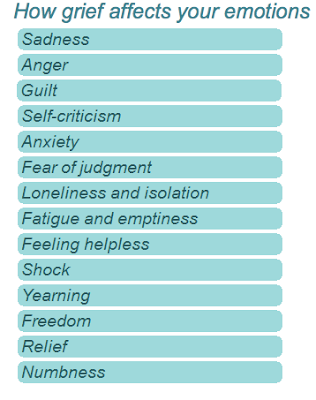

Grief - is your personal response to loss.
Bereavement - is the time spent grieving after someone important to you dies.
Mourning - is how you express your grief outwardly

When grieving you might:
- spend a lot of time thinking about the loss
- have table staying focused & doing day to day activities
- have health implications
- have episodes of strong & unpredictable emotions or reactions
- be in disbelief
- being forgetful
- think they see or hear things that are not there


Friday, May 24, 2019
May 21 - 24
Self-regulation: involves controlling one's behavior, emotions, & thoughts
Emotional self-regulation: the ability to manage disruptive emotions and impulses

When a child is unable to self regulate, learning is impacted.
Signs a child is struggling:
- trouble falling asleep or staying asleep
- being crabby in the morning
- easily upset
- explosive mood
- trouble maintaining attention / listening
- signs of frequent sadness, anxiety, fear, anger
Possible causes:
- not enough sleep
- did not have enough physical activity
- too much screen time
- poor nutrition (too much sugar or processed food)
- overstimulated (sounds, sights, lights, crowds)
Steps to help with regulation:
- know the signs that lead up to a blow out or melt down
- ID the stressors / environments that challenge the child
- overall reduce the stress placed on the child
- in a calm moment, chat with the child about their triggers & strategies that help
- practice calming methods or breathing exercises

Emotional self-regulation: the ability to manage disruptive emotions and impulses

When a child is unable to self regulate, learning is impacted.
Signs a child is struggling:
- trouble falling asleep or staying asleep
- being crabby in the morning
- easily upset
- explosive mood
- trouble maintaining attention / listening
- signs of frequent sadness, anxiety, fear, anger
Possible causes:
- not enough sleep
- did not have enough physical activity
- too much screen time
- poor nutrition (too much sugar or processed food)
- overstimulated (sounds, sights, lights, crowds)
Steps to help with regulation:
- know the signs that lead up to a blow out or melt down
- ID the stressors / environments that challenge the child
- overall reduce the stress placed on the child
- in a calm moment, chat with the child about their triggers & strategies that help
- practice calming methods or breathing exercises

Friday, May 17, 2019
May 13 - 17
Adverse Childhood Experiences (ACE): are highly stressful, and potentially traumatic, events or situations that occur during childhood and/or adolescence
I have been reading a lot of articles & been to a few professional development sessions on ACE. It has opened my eyes to not only how prevalent they are but the many implications they have on a child’s brain development, learning, overall health & social interaction.
ACE include:
ACE include:
- Emotional abuse
- Physical abuse
- Sexual abuse
- Neglect
- Household substance abuse
- Household mental illness
- Separation / divorce
- Death of a parent
- Witnessing abuse / violence
- Racism
- Sexism
- Homelessness
- Natural disasters
- Incarcerated parent
ACE increase risk of:
- Adolescent pregnancy
- Alcohol abuse
- Drug abuse
- Depression
- Heart & liver disease
- Smoking
- Suicide attempts
- Earlier sexual experiences
- STD’s
- Teenage pregnancy
- Partner violence
- Incarceration
How ACE effect health:
- Reduces the ability to learn
- Lowers tolerance to stress
- Difficulty making & maintain friendships
Struggle with understanding, reading & regulating feelings
Increased rate of depression / anxiety
Higher risk of self harm
Struggle with understanding, reading & regulating feelings
Increased rate of depression / anxiety
Higher risk of self harm
- Difficulty with memory
- Physical health issues – heart rate, blood pressure, diabetes, obesity


Subscribe to:
Posts (Atom)
April 3
Thank you for being so patient & supportive as we navigate this very unique time in history. We are doing our best to build the boat wh...

-
 Monday was cold. cold, cold. With it being minus 22 with windchill we stayed in side for recess. We had some fun though & tried to be...
 -
 Tantrum : an outburst of anger and frustration, typically in a young child Meltdown : a loss of control of one's temper Young ch...
 -
 In word work we learnt about similes. They are a comparison between 2 things using like or as. For art this week we did a paper craft,...